
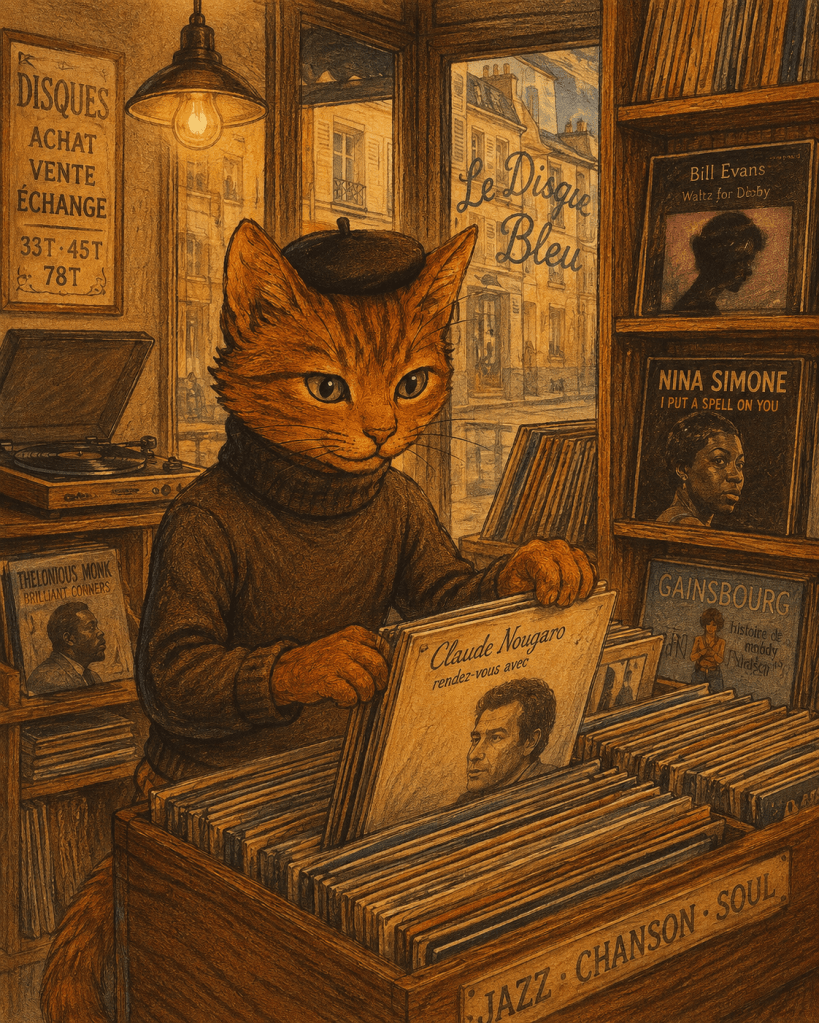
Tonight I am listening to one of my favourite artists – Thelonious Monk, this time going back to 1967 and in Paris.
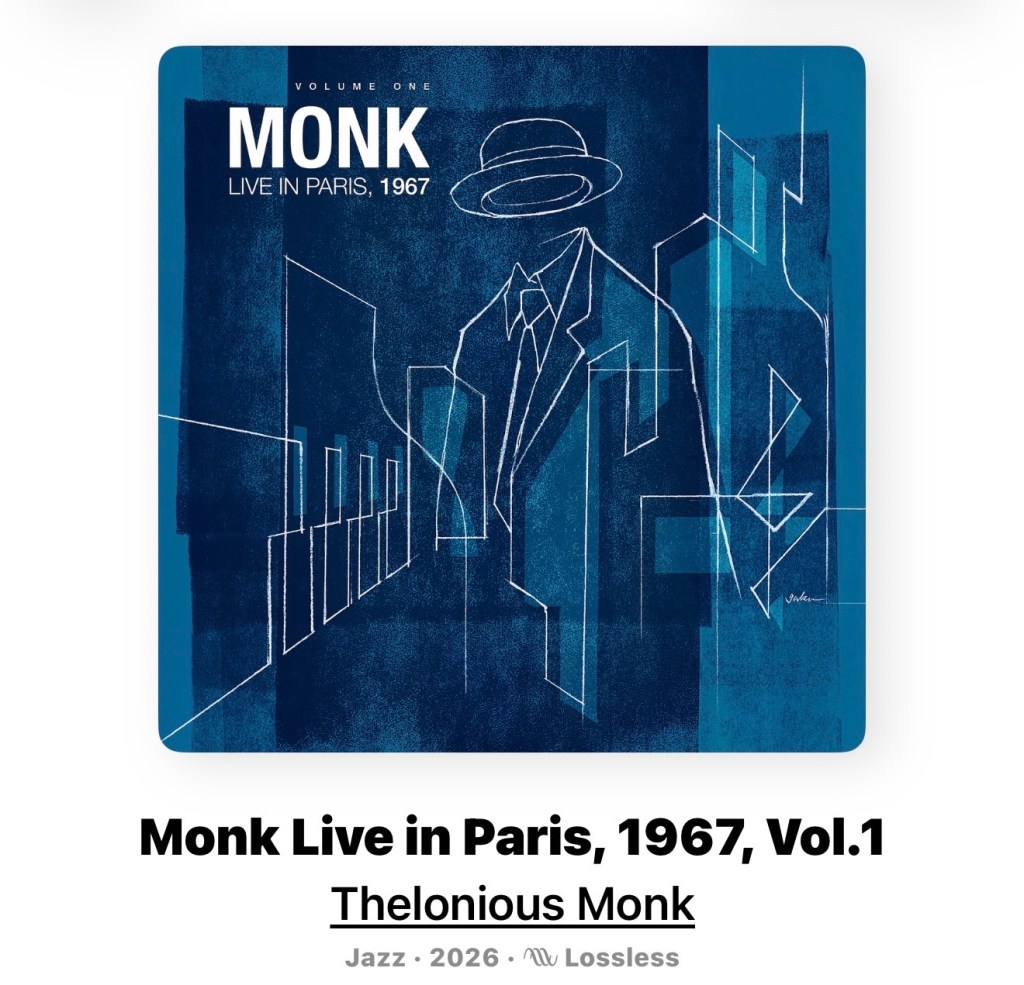
⭐ Overview — Monk Live in Paris, 1967, Vol. 1
This album feels like opening a time capsule sealed in cigarette smoke, brass heat, and the strange geometry of Monk’s mind. It’s Paris in ’67 — a city already humming with artistic electricity — and Monk arrives not as a visitor but as a gravitational force.
What makes this recording special is the ensemble energy: Griffin and Woods sparring like fencers, Rouse weaving that familiar warm reed‑tone, Copeland and Cleveland adding colour, and Riley/Gales locking the pulse with absolute trust.
It’s not a “greatest hits” set — it’s a portrait of Monk in motion, caught mid‑stride, mid‑thought, mid‑alchemy. The performances feel lived‑in, conversational, and gloriously imperfect in the way only real jazz can be.
🎵 Track‑by‑Track Review
- Introduction (Live)
A short doorway into the room. You hear the ambience, the crowd settling, the musicians adjusting their instruments. It’s the sound of anticipation — that moment before Monk’s angular universe snaps into place.
It sets the tone: we’re not listening to a studio artefact; we’re entering a night.
- Epistrophy (Live)
This is the first real ignition point.
“Epistrophy” is Monk’s labyrinth — sharp corners, sudden drops, rhythmic puzzles — and here it becomes a multi‑horn conversation.
- Griffin and Woods trade lines like two poets arguing in different dialects.
- Copeland’s trumpet cuts through with bright, metallic punctuation.
- Rouse, ever the loyal interpreter, threads Monk’s logic into something warm and human.
- Riley and Gales keep the whole thing from flying apart, grounding the chaos with swing.
It’s exhilarating, slightly unruly, and absolutely alive.
- Evidence (Live)
If “Epistrophy” is the maze, “Evidence” is the courtroom.
Monk presents his musical argument with clipped phrases, unexpected silences, and those trademark rhythmic nudges that feel like he’s testing the floorboards.
The horns respond like witnesses:
- Woods brings sharp articulation,
- Griffin adds swagger,
- Copeland and Cleveland give the brass section a muscular presence,
- Rouse ties it all together with that warm, rounded tone.
It’s witty, sly, and full of Monk’s sideways humour.
- Ruby, My Dear (Live)
A complete mood shift — suddenly the room softens.
This is Monk at his most tender and architectural, building emotion through space rather than density.
Rouse shines here. His playing is intimate, almost confessional, and Riley/Gales give him the gentlest frame to lean against. Monk’s piano feels like someone touching a memory with careful fingertips.
It’s the emotional heart of the set.
- We See (Live)
A perfect closer.
“We See” has that sly Monk grin — playful, slightly off‑centre, full of rhythmic mischief.
Copeland’s trumpet adds sparkle, Rouse dances around Monk’s phrases, and Riley/Gales keep the groove loose but insistent. It feels like the band is enjoying themselves, leaning into Monk’s quirks rather than smoothing them out.
It leaves you with the sense of a night well spent — not polished, not perfect, but deeply human.
🎼 Final Thoughts
Monk Live in Paris, 1967, Vol. 1 is a snapshot of a master surrounded by musicians who understand his language and relish the challenge of speaking it. It’s warm, angular, funny, emotional, and unmistakably Monk.
By 1967, Monk was 50 years old — a veteran, a survivor, and a legend. He had spent decades fighting for recognition in the United States, often misunderstood by critics who didn’t know what to do with his eccentricities. But Europe understood him.
This period marks:
- His late‑career touring peak, with the classic quartet (Charlie Rouse, Larry Gales, Ben Riley) forming the backbone of his sound.
- A shift toward more spacious, architectural playing — fewer notes, more meaning.
- Increasing physical and emotional fatigue, which gave his performances a kind of haunted beauty.
Paris was one of the places where he still felt energised, still willing to push, still capable of those sudden bursts of angular brilliance.

